You’re planning a trip to Japan, and somewhere on your list is a Japanese onsen or sento. But before you go, one question tends to stop people in their tracks:
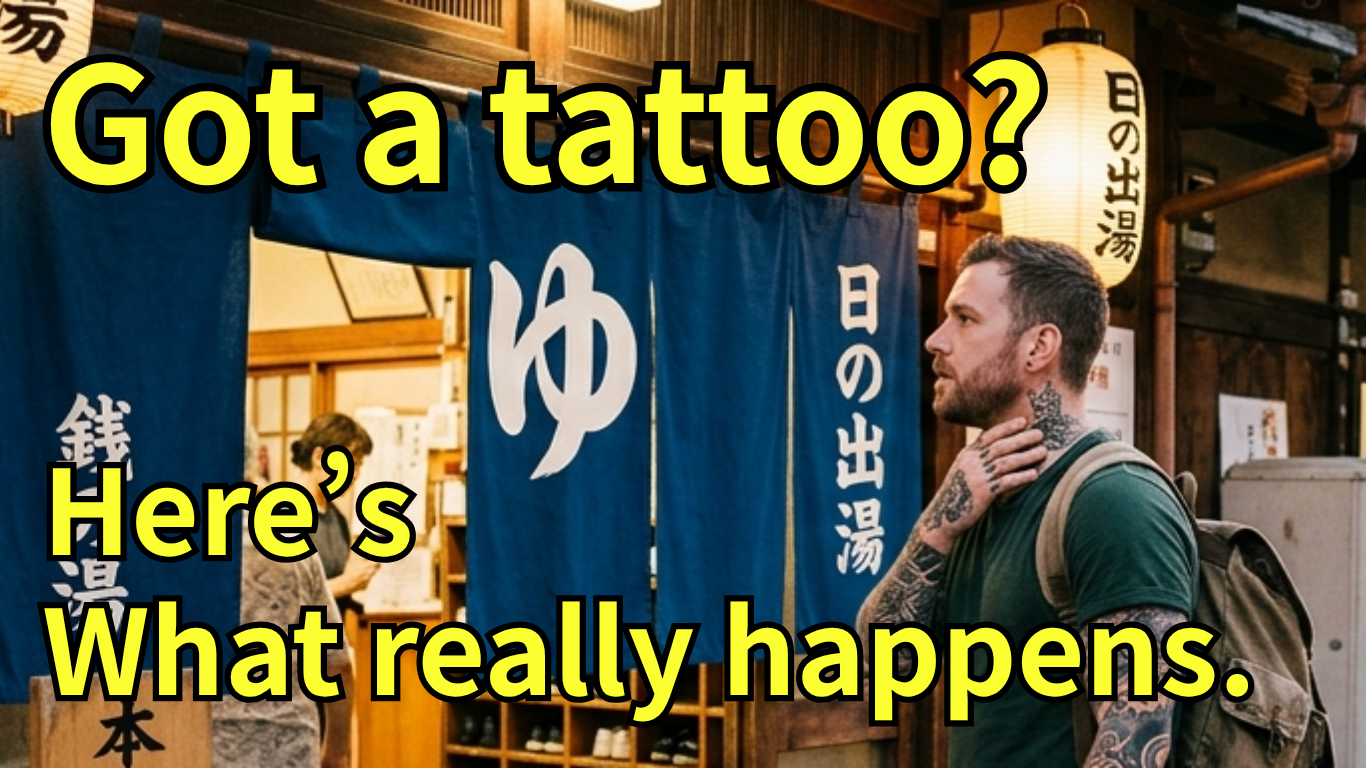
If I have a tattoo, can I actually get in?
It’s a fair question. And the honest answer isn’t a simple yes or no — it’s more nuanced than that.
By the end of this guide, you’ll know exactly how to handle it. You’ll also learn the one step almost everyone gets wrong the first time they use a Japanese bath, and a few things that might surprise you — including a bath that intentionally gives you a mild electric shock.
Watch the full video first — Shohei and Mio walk you through the whole experience:
Main Point Summary
Here is what this guide covers:
- The difference between an onsen and a sento
- The step-by-step process for using either one
- Why you wash before getting in — and what it says about Japanese culture
- The tattoo policy, where it comes from, and your practical options
- A few smaller details that make a real difference
Onsen vs. Sento: What’s the Difference?
Both involve soaking in a communal bath, but the water source is different.
Onsen – Natural Hot Springs
An onsen uses water that comes from underground. It is naturally heated and usually contains minerals — which is part of why people travel specifically to visit one. You’ll find onsen resorts across Japan, from mountain towns to coastal areas.
Most onsen resorts offer both an indoor bath and an outdoor bath called a rotenburo. Soaking in a rotenburo while looking out at a garden, a forest, or falling snow is often the highlight of the whole visit.
Sento – Public Bathhouses
A sento is a public bathhouse, and you’ll find them in neighborhoods all over Japanese cities. Most use heated tap water, though some sento do draw on real hot spring water too.
Historically, sento existed because many homes in Japan didn’t have their own bath. Today, people still go for the experience — and honestly, for the size of the tub alone. A neighborhood sento usually has a simpler, all-indoor setup with a few tubs at different temperatures. Some also have a sauna and a cold plunge pool, which regulars cycle between for the contrast.
How to Use a Japanese Bath: Step by Step
The process is roughly the same at both an onsen and a sento.
Take off your shoes at the entrance and store them in a locker or shoe rack.
Pay at the front desk or show your ticket.
Head to the changing room and look for a curtain or sign with a color and a character.
Red usually marks the women’s side, blue the men’s. Baths in Japan are separated by gender, with very few exceptions.
Undress completely and store your things in a locker or basket.
Walk into the bathing area — and this is where the most important step comes in.
The One Rule Almost Everyone Gets Wrong
Before you get into the tub, wash your whole body thoroughly.
Along the wall, you’ll find washing stations — a low stool, a handheld shower, and usually soap and shampoo. Sit down and wash everything, just like you would at home.
A lot of first-time visitors wonder: Am I considered dirty? Not at all.
It’s not about that. The tub is shared. Everyone who gets in afterward is sharing that same water.
Washing first keeps it clean and comfortable for everyone — including you.
Once you see it that way, it stops feeling like a strict rule and starts feeling like common courtesy.
There’s a bigger idea underneath it, too.
In Japan, once you step outside your home, that space is treated as shared.
There’s an unspoken expectation to keep it clean and pleasant for whoever comes next. You’ll notice the same instinct on trains, in parks, pretty much everywhere. The bath is just one more example of it.
One more small thing: the little towel you’re given is for washing and for a bit of modesty as you walk around — but it doesn’t go into the bathtub itself. Most people fold it and set it on the side, or rest it on their head.
Can You Go to an Onsen With a Tattoo?
Some onsen and sento still turn away guests with visible tattoos. This surprises a lot of visitors — and it’s worth understanding where the policy comes from.
Why the Policy Exists
The policy isn’t a random quirk. It has a specific historical root.
In Japan’s past, tattoos were used as a form of criminal punishment —
a mark branded onto people who had broken the law.
That history is deep, and it still shapes how many people in Japan feel about tattoos today, particularly in spaces where everyone is undressed and vulnerability is part of the experience.
Attitudes are slowly shifting. Younger generations increasingly see tattoos as fashion or self-expression. But even with that shift, a significant portion of the Japanese public still feels uncomfortable seeing tattoos in a shared bathing space.
When a facility has a no-tattoo policy, it isn’t an arbitrary rule. It reflects that history and the comfort of other guests. As a visitor, it’s meant to be respected.
Your Options: Tattoo-Friendly Onsen and Private Baths
The good news: the landscape is changing, and you have real options.
A growing number of onsen and sento now explicitly welcome guests with tattoos. Many are listed on travel apps and websites specifically for this reason. If you have tattoos, checking in advance takes only a few minutes and saves a lot of uncertainty.
Some facilities allow guests with smaller tattoos to cover them with waterproof stickers. It’s worth asking if this is an option at the place you’re visiting.
This option works regardless of tattoo policy. You book an entire bathing room for your group for a set amount of time. No shared space, no policy to navigate — it’s just yours. Kashikiri is available at many onsen resorts and some sento, and it’s a genuinely relaxing way to experience a Japanese bath without any of the uncertainty.
A Few More Things to Know
Once you have the main steps down, these smaller points make the experience smoother.
Tie it up so it doesn’t touch the water.
Leave them in your locker. It’s a shared space where everyone is undressed, so this is about basic respect for the people around you — not just a rule.
The water can be hotter than you expect, especially at an onsen. Ease in slowly rather than jumping straight in. And don’t feel like you need to stay submerged for a set amount of time. A few minutes at a time, with breaks between, is completely normal.
Some sento — found mostly in western Japan — have a section called denkiburo, where a mild electric current runs through the water. Locals use it for sore muscles. It typically starts as a faint tingling and gets stronger the closer you get to the metal plates. Most people test it with a foot or a hand first. It’s less common in eastern Japan, so you may not come across it on your visit — but if you do, now you know what it is.
Onsen and Sento FAQ
Conclusion
Once you know these few things, a Japanese bath stops feeling like a test you might fail and starts feeling like one of the most relaxing parts of your trip.
Wash before you get in. Keep your towel out of the tub. Check the tattoo policy in advance — and know that a kashikiri private bath is always a comfortable option if you’d rather not think about it.
The rest, you’ll figure out easily once you’re there.
If this guide helped, the full video goes deeper — Shohei and Mio walk you through the whole experience together. Subscribe to SSJ101 for more guides like this one: the small details that make a big difference when you’re traveling in Japan.
📺 Subscribe to SSJ101 on YouTube

Need More Help Planning Your Japan Trip?
We have collected useful official links, travel resources, and booking options for first-time visitors to Japan.
Use this page when you want quick access to trusted resources before or during your stay.
Japan can feel easier to navigate when you know where to find reliable information.
Our Useful Links page gathers practical resources for visitors.
\ For a Smoother Stay in Japan /