Why Train Etiquette Advice in Japan Always Seems to Contradict Itself
If you’ve spent any time researching train etiquette in Japan, you’ve probably noticed something frustrating: the advice doesn’t agree with itself.
One blog post tells you, in no uncertain terms, “Never eat or drink on a Japanese train — it’s considered extremely rude.” Then you land in Japan, sit down on a packed morning train, and the person next to you is calmly sipping a can of coffee like it’s nothing.
So which one is correct?
Actually, both are. The reason the advice feels contradictory is that Japan doesn’t have a single set of train rules. It has different unwritten rules for different types of trains — and almost no guide explains where the line actually falls.
That’s exactly what this article is for. By the end, you’ll know what’s fine on a local train, how things change once you’re on the Shinkansen, and one often-overlooked seating option that comes with its own quiet code of behavior: the Green Car.
Eating and Drinking on Local Trains: The 3-Level Rule
Let’s start with the train you’ll use the most during your trip: the local train (commuter trains, city subways, and regional lines).
Many first-time visitors believe that eating and drinking is completely banned on these trains. That’s not quite right. The reality is less about a written rule and more about reading the situation — and it breaks down into three simple levels.
Level 1 — Drinks
A bottle of water, a can of coffee, a cup of tea from the convenience store: this is genuinely a non-issue.
Japanese commuters do this every single day, often first thing in the morning on their way to work. Nobody will look twice.
Level 2 — Light Snacks
Something small, not messy, and without a strong smell — a few candies, a small piece of bread, a granola bar. In most situations, especially on a quieter train, this is perfectly acceptable.
The key word here is smell.
Open something with a strong aroma — fried food, a tuna sandwich, anything pungent — in a packed train car, and that’s when people around you start to feel uncomfortable. It’s not that you’ve broken a rule; it’s that you’ve changed the shared environment for everyone else in it.
Level 3 — Full Meals
A rice bowl, a burger, a bento box that takes time, space, and both hands to eat.
On a local train, this is something most people simply don’t do.
It’s an Unspoken Agreement, Not a Rule
Here’s the part that’s easy to miss: there’s no sign anywhere that says “no full meals.” It comes from something deeper about how local trains function in daily life.
A local train in Japan is part of daily life. It carries people to work and school, often packed shoulder to shoulder during rush hour. In that kind of crowded, shared space, people instinctively try not to take up more than their fair share — not with their bags, not with their voice, and not with the smell of their lunch.
Nobody announces this agreement, and nobody enforces it. Everyone just protects the space for everyone else. So when you keep your snack small and your drink simple, you’re not just following a rule —
you’re taking part in that same quiet agreement.
And people notice, even if they never say anything.
Why the Shinkansen Is a Different Story
This is where everything you just learned starts to shift — because the Shinkansen (Japan’s bullet train) is a fundamentally different kind of train.
The Shinkansen isn’t built around the idea of a daily commute, even though a small number of people do use it that way — it’s not unusual to meet someone who commutes into Tokyo from a city like Odawara or Atami. But for most passengers, a Shinkansen ride means a single, longer journey: two, three, sometimes four hours at a stretch. And it’s used by everyone — tourists exploring the country, yes, but just as often business travelers heading to a meeting in another city.
In other words, for the vast majority of passengers, it’s not a “vacation train” —
it’s simply a long journey.
And on a long journey, the rules around food naturally relax.
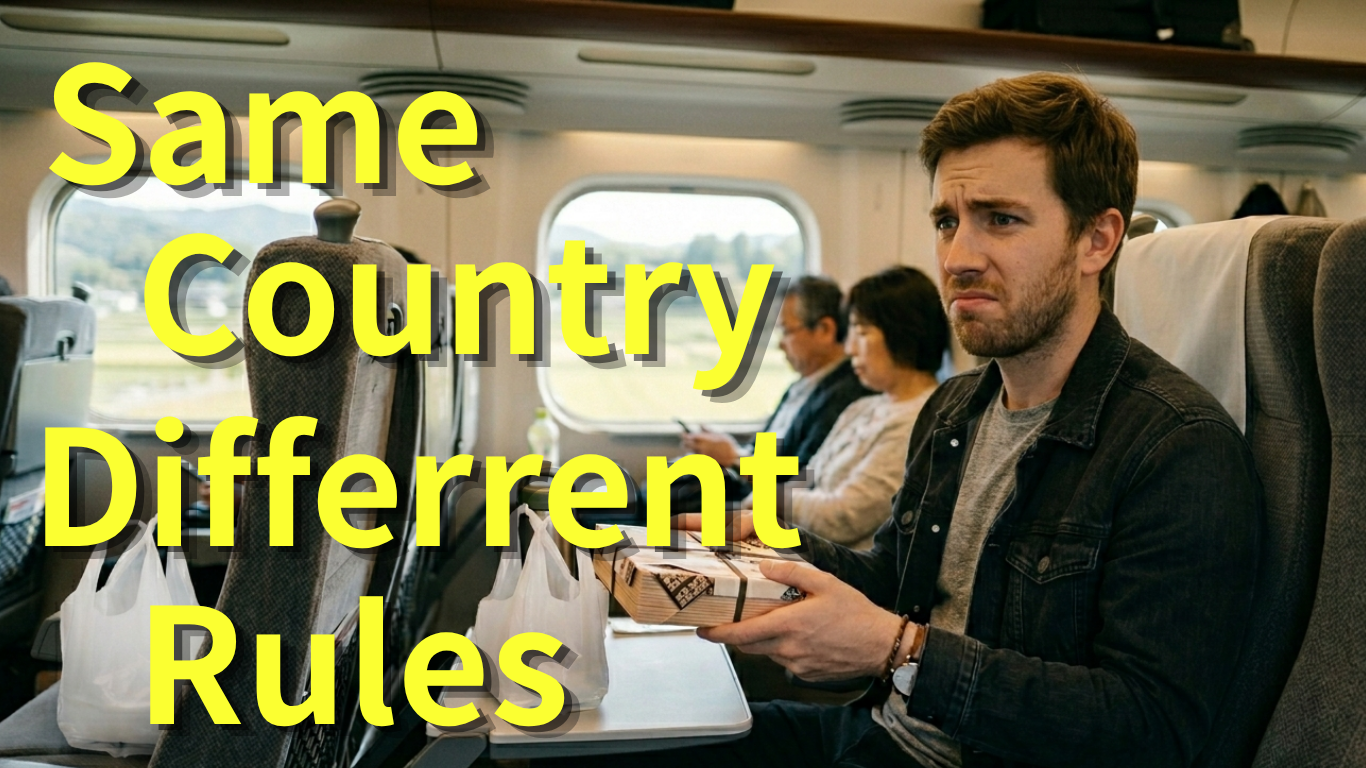
When you’re on a train for hours, eating isn’t an inconvenience to the people around you — it’s expected. The seats are wider, and there’s a fold-down tray table in front of you, just like on an airplane. The whole space is designed with the assumption that passengers will eat, drink, and settle in for the ride.
So on the Shinkansen, the question isn’t “is it okay to eat?” — it’s “what should I eat?” And that brings us to one of the most enjoyable parts of long-distance train travel in Japan.
Ekiben — Japan’s Train Bento Culture Worth Trying
This brings us to one of the most enjoyable parts of long-distance train travel in Japan: ekiben (駅弁), bento boxes sold specifically for train journeys.
Many ekiben feature ingredients and specialties from a particular region — a way of “tasting” the place you’re traveling through, whether that’s a beef bento from Yonezawa or a seafood bento from Hokkaido. A lot of travelers see picking one up before boarding and eating it on the Shinkansen as part of the experience itself.
To be clear, this isn’t a requirement. Plenty of passengers just ride and rest, and that’s completely normal too. But it is a tradition with real history, and if you choose to try it, you’re taking part in something Japanese travelers have enjoyed for generations.
So on the Shinkansen: eat, enjoy your ekiben, and take your time. The space is genuinely built for it. Just one practical note — once you’re done, fold up any wrapping and keep it at your seat until you can dispose of it properly, either in the bins near the doors or after you get off.
Shinkansen Seating Types: Non-Reserved, Reserved, and Green Car
Before we move on, there’s one more thing to understand about the Shinkansen — and it’s the part that catches most visitors completely off guard:
not all seats are the same.
The Shinkansen has three types of seating: a non-reserved car where you take any open seat, a reserved car where you book a specific seat in advance, and the Green Car — Japan’s first-class equivalent.
Here’s the pattern worth remembering: as the comfort level of the space goes up, so does the level of quiet and care expected around you.
Non-Reserved and Reserved Seats
Non-reserved cars (自由席) and reserved cars (指定席) are where most travelers sit, and the etiquette here is essentially what we’ve already covered: eating, drinking, and ekiben are all welcome. The main difference between the two is simply whether your seat is guaranteed — non-reserved seats are first-come, first-served, while reserved seats are booked in advance for a specific car and seat number.
In terms of food and noise, both feel like a normal long-distance train carriage: people chat, eat, nap, and work, all at a relaxed volume.
The Green Car
The Green Car is a different atmosphere altogether. Think of it as the business class of Japanese trains — the seats are wider, there’s more legroom, and because the tickets cost more, there are simply fewer people on board. The result is a calmer, quieter environment overall.
And that’s exactly why it matters for you as a visitor. We’ll look at what that means in practice next.
The Green Car’s Unspoken Code
The Green Car has an atmosphere — and that atmosphere comes with an unspoken expectation that isn’t written on any sign, but that everyone on board seems to understand.
Why the Atmosphere Feels Different
In the Green Car, people speak softly, if at all. Phone calls are generally avoided, or taken in the area between cars. The whole point of the space is calm — it’s less “train carriage” and
more “quiet lounge that happens to be moving at 280 km/h.”
This is where the most common mistake happens. Visitors book the Green Car for the extra comfort — the wider seat, the legroom, the lower ticket-to-passenger ratio — without realizing that the comfort comes bundled with a quieter code of behavior. So if you’re traveling with friends, excited and chatting and laughing the way you might on a regular reserved car, the Green Car may not be the right setting for that energy.
It’s not that you’d be breaking a rule, exactly. There’s no attendant who will ask you to be quiet. It’s that you’d likely feel the room go quiet around you — conversations dropping to whispers, people glancing over — and you might not immediately understand why. That feeling of “did I do something wrong?” is, for many visitors, the first real moment of culture shock on an otherwise smooth trip.
How to Match the Room
The good news is that none of this requires special knowledge or Japanese language ability — just a quick read of the room when you sit down.
A few practical cues: keep conversation to a low volume, similar to how you might talk in a hotel lobby. If you need to take a call, step into the space between cars. Eating and drinking, including ekiben, is completely fine in the Green Car — just be mindful of strong smells and rustling packaging, the same as you would in any quiet shared space.
To be clear, the Green Car is entirely optional. You don’t need it to enjoy the Shinkansen — the regular reserved and non-reserved cars are perfectly comfortable for most travelers. But if you want extra space and a calmer ride, it’s a wonderful choice, as long as you match the atmosphere when you step in. Read the space, and the space will welcome you.
Quick Reference: What’s Okay, By Train Type
If you only remember one thing from this article, let it be this table.
| Train Type | Drinks | Light Snacks | Full Meals | Atmosphere to Expect |
|---|---|---|---|---|
| Local trains / subways | Always fine | Usually fine (avoid strong smells) | Generally avoided | Crowded, shared daily-life space |
| Shinkansen — non-reserved / reserved | Fine | Fine | Fine — ekiben encouraged | Relaxed, long-journey atmosphere |
| Shinkansen — Green Car | Fine | Fine | Fine, but keep it tidy and low-key | Quiet, calm, soft voices |
A simple way to think about it: the more crowded and “everyday” the train, the more compact your food and drink should be. The longer the journey and the more spacious the seat, the more relaxed you can be — as long as you stay aware of the people around you.
Final Tips for a Smooth Ride
If there’s one thing to take away from all of this, it’s that Japanese train etiquette isn’t really about a rulebook — it’s about reading the room, literally.
To recap:
- On a local train, drinks are fine, small snacks are usually okay, but save full meals for later. It’s about protecting a crowded, shared space.
- On the Shinkansen, the journey is long, so eating is welcome — and an ekiben is a lovely way to make the ride part of the trip.
- The Green Car offers extra comfort, but it asks for a bit of extra quiet in return.
And here’s one small piece of advice: next time you’re at a station before a long-distance ride, take a minute to look at the ekiben selection — even if you don’t end up buying one. Something about it makes the trip feel a little more like Japan.
These small, unspoken rules are part of what makes traveling in Japan feel different — and once you understand them, the whole experience gets a little smoother. Safe travels.
Helpful Japan Travel Booking Resources
Planning your Japan trip?
If you want to book airport transfers, local transport passes, attraction tickets, or travel activities in advance, Klook can be a helpful option for comparing travel services before your trip.
\Explore Japan Travel Deals /