Japan looks incredibly modern at first glance.
Bullet trains, vending machines, convenience stores, QR codes, and spotless train stations — it all paints a picture of a fully cashless country. So it is easy to assume that your card will work just about everywhere.
But once you arrive, you may notice something a little unexpected:
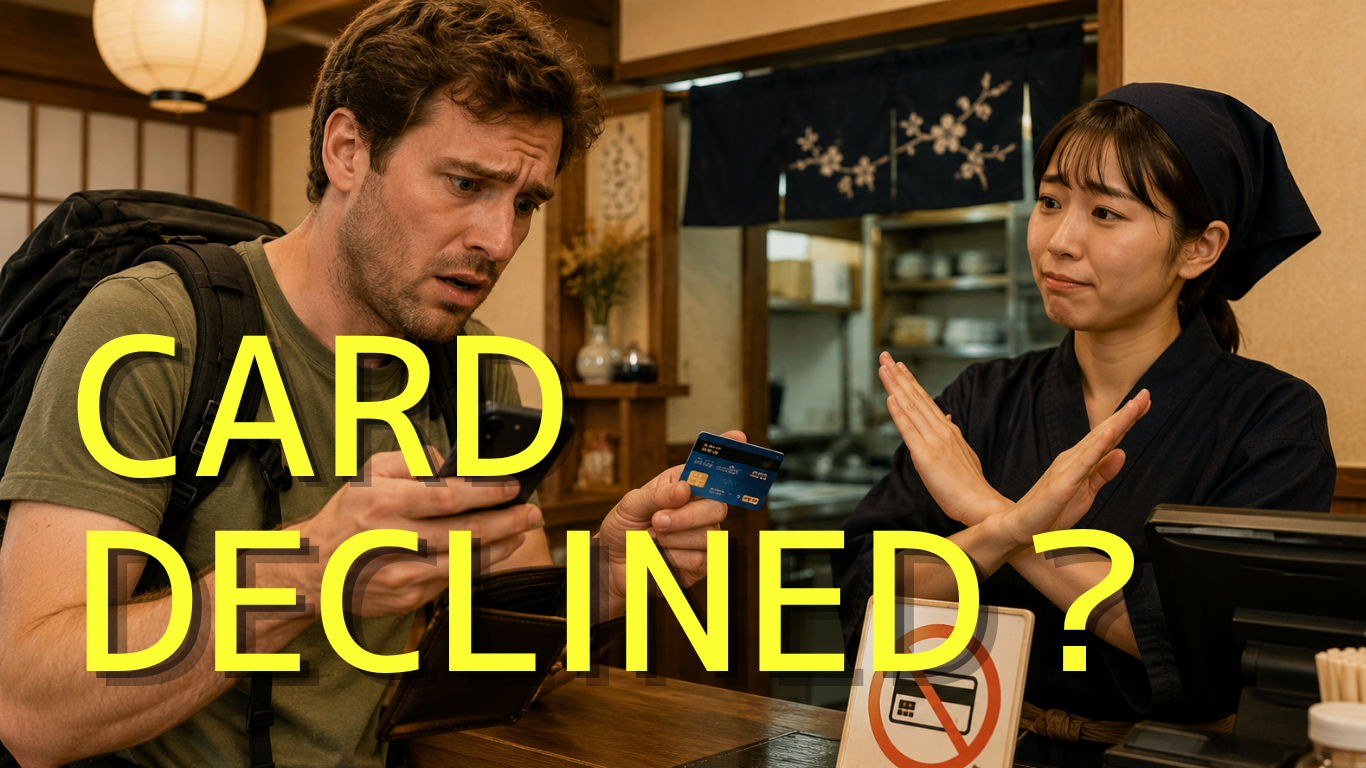
A large hotel may accept your credit card without any issue, but a small noodle shop down the street may prefer cash.
A convenience store may support several payment methods, but a local bus or temple entrance may still require cash.
A train station may be a breeze with an IC card, but topping up that card might still require cash at the machine.
None of this means Japan is inconvenient. It simply means that navigating payments works best when you come prepared with more than one option.
According to the Japan Tourism Agency’s FY2025 survey of inbound travelers, “credit/debit card use” ranked among the top seven difficulties reported by visitors — with 10.7% saying they experienced trouble with it. The same survey also notes that this figure has continued to rise since FY2023.
This guide is not here to make payment in Japan sound difficult. It is here to help your trip go as smoothly as possible.
By the end, you will know when cash is the safest option, when a credit card works perfectly, when an IC card like Suica makes life easier, and how to handle payment moments in Japan with confidence.
Watch the Full Video
If you would rather take this in through a relaxed, podcast-style conversation, the full video is right here:
In the video, Shohei and Mio walk you through why Japan can feel both beautifully modern and charmingly old-fashioned when it comes to payment — and share the simple habits that can help make your trip go smoothly.
Main Point Summary
Here is what you need to know:
- Japan is not fully cashless — even though many places do accept cards.
- Credit cards work well at hotels, department stores, chain restaurants, larger restaurants, and major tourist facilities.
- Cash still comes in handy at small restaurants, temples, shrines, rural areas, coin lockers, some local buses, and some ticket machines.
- IC cards like Suica are incredibly useful for trains, buses, convenience stores, vending machines, and quick everyday payments.
- The smartest approach is not “cash only” or “card only.” Instead, think of it as a simple three-part setup: a credit card, an IC card, and a little cash.
Here is one way to picture it:
Your credit card handles the bigger purchases. Your IC card keeps you moving and covers small daily buys. Your cash is your backup — and your key to local everyday life.
Why Japan Is Not Fully Cashless Yet
Japan has come a long way toward going cashless, especially in its larger cities. In places like Tokyo, Osaka, Kyoto, and other major tourist areas, credit cards, transit IC cards, and mobile payment systems are now widely accepted.
That said, there is one detail worth knowing before you arrive.
The Japan National Tourism Organization notes that IC travel cards can be used for both transportation and small cashless payments. However, if you are using a physical IC card, topping it up at many station machines generally requires cash rather than a credit card. JR East’s official Suica information also states that Suica cards can be topped up with cash at ticket machines, and that Suica cards cannot be topped up using a credit card.
This is the kind of “Japan payment gap” that tends to catch visitors off guard.
Cards are accepted in many places across Japan, but not always in the way you might expect based on your home country. Some systems are genuinely convenient once you get the hang of them — but they may work a little differently from Apple Pay, contactless cards, or the transit systems you are used to.
A few reasons help explain this:
Many small businesses are family-run and have long operated on a cash basis.
Some older payment machines were built before international cards became widely used.
Local buses, temples, shrines, and small restaurants often run on straightforward cash-based systems.
And in more rural areas, cashless infrastructure can be less consistent.
The takeaway is simple:
The Best Payment Setup for First-Time Visitors
For most first-time visitors, this three-part setup tends to work really well:
| Payment Method | Best For |
|---|---|
| Credit card | Hotels, large stores, restaurants, online bookings |
| IC card / Suica | Many trains and buses, convenience stores, many vending machines, small everyday payments |
| Cash | Small shops, temples, shrines, local restaurants, emergencies |
This combination gives you real flexibility.
You do not need to carry a large amount of cash with you every day. But having some yen on hand can take a lot of the stress out of those moments when a place does not accept your card.
A good habit to build:
keep enough cash for small meals, local transportation, temple or shrine visits, coin lockers that do not accept IC cards, and anything unexpected that comes up along the way.
When Credit Cards Usually Work Well in Japan
Credit cards are widely accepted across Japan, particularly in places that regularly welcome tourists.
In general, you can expect credit cards to work at:
- Hotels
- Large department stores
- Shopping malls
- Chain restaurants and larger restaurants
- Airport shops
- Major tourist attractions
- Many convenience stores
- Online booking services
- Some taxis
That said, “usually” is not quite the same as “always.”
Before you order at a small restaurant, take a quick look near the entrance or the register — credit card logos are often displayed there. If you are still not sure, it is perfectly fine to ask:
“Can I pay by card?”
In Japanese:
Even if your pronunciation is not perfect, showing your card and asking politely is usually enough to get the message across.
When Cash Is Still Useful
Cash still goes a long way in Japan.
You will likely find it helpful at places like:
- Small ramen, soba, or local restaurants
- Food stalls
- Some temples and shrines
- Small museums or local attractions
- Rural shops
- Some local buses
- Coin lockers that do not accept IC cards
- Some ticket machines
- Small guesthouses or older facilities
- Places with “cash only” signs
Cash also comes in handy when your card does not go through — and sometimes that has nothing to do with your account.
A foreign card may not work because of the terminal, the card network, your bank’s security settings, or the type of payment machine being used. In those moments, having cash on hand turns a potentially awkward situation into a quick, easy one.
There is no need to stress about it. A little preparation goes a long way.
Why IC Cards Like Suica Are So Useful
An IC card like Suica is one of the most practical tools you can have while traveling in Japan.
You can use it to tap in and out of many train and bus systems — and beyond transportation, it also works at many convenience stores, vending machines, some coin lockers, and even some restaurants and shops.
JR East describes Suica as prepaid electronic money that can be used for trains, buses, shopping, and more.
For day-to-day travel, this can take a surprising amount of small friction out of your trip.
Instead of buying a paper ticket each time, you simply tap your card. Instead of counting coins at a vending machine, you tap your card. Instead of reaching for your credit card for every small purchase, your IC balance handles it quietly and quickly.
There is one thing worth keeping in mind, though:
An IC card is not a full replacement for cash or a credit card.
It works brilliantly for small payments and getting around, but it may not be accepted everywhere. And depending on the card type and how you top it up, adding money to your card may still require cash — especially if you are topping up a physical card at a station machine.
Think of Suica as your go-to card for smooth daily movement — a genuinely useful tool, but best used alongside cash and a credit card, not instead of them.
Common Payment Situations Visitors May Face
| Situation | Best Payment Method | Simple Advice |
|---|---|---|
| Hotel check-in | Credit card | Usually straightforward, but it is worth having a backup card just in case |
| Convenience store | Card, IC card, or cash | IC card is especially smooth for quick, small purchases |
| Ramen or soba shop | Cash or ticket machine payment | Take a quick look before you order — many smaller places prefer cash |
| Train or subway | IC card | Suica or another IC card tends to be the easiest option |
| Temple or shrine | Cash | A few coins and small bills will go a long way |
| Local bus | IC card or cash | It is worth checking before you board — some rural buses may still require cash |
| Vending machine | IC card or cash | IC card is a convenient choice where accepted |
| Taxi | Card, cash, or taxi app where available | Look for payment stickers on the window, or ask before you get in |
| Small town restaurant | Cash | It is always a good idea to have cash ready, just in case |
Useful Japanese Phrases for Payment
You do not need perfect Japanese — just a few simple phrases can make a real difference.
| English | Japanese | How to Say It |
|---|---|---|
| Can I pay by card? | カードは使えますか? | Kaado wa tsukaemasu ka? |
| Can I pay with Suica? | Suicaは使えますか? | Suica wa tsukaemasu ka? |
| Cash only? | 現金だけですか? | Genkin dake desu ka? |
| Do you accept credit cards? | クレジットカードは使えますか? | Kurejitto kaado wa tsukaemasu ka? |
| Thank you. | ありがとうございます。 | Arigatou gozaimasu. |
Your pronunciation does not need to be perfect — the simple act of trying goes a long way. If you are not confident speaking, you can also pull up this phrase on your phone and show it directly. Most people will appreciate the effort.
A Simple Rule: Use the 3-Layer Payment Plan
The simplest way to avoid payment surprises in Japan is to come prepared with a 3-layer plan.
Layer 1: Credit Card
Use your credit card for hotels, larger purchases, and places where cards are clearly accepted.
If possible, bring at least two cards — one card may simply not work with a particular terminal, and having a backup takes the worry out of it.
Layer 2: IC Card
Use Suica or another IC card for many trains and buses, convenience stores, many vending machines, and small everyday payments.
Once you get into the habit, it makes moving through Japan feel noticeably smoother.
Layer 3: Cash
Keep cash on hand for small restaurants, temples, shrines, rural areas, some local buses, and any situations where the other two layers fall short.
It is also worth carrying a mix of smaller bills and coins, rather than relying only on large ¥10,000 notes.
This 3-layer plan is simple, practical, and flexible — and it helps you sidestep the most common assumption visitors make: that Japan is either “cash only” or “fully cashless.”
The reality sits comfortably in between.
You Do Not Need to Be Perfect
If your card does not go through, there is no need to worry.
If you happen to walk into a cash-only restaurant, that is completely fine. And if you are ever unsure which payment method to use, a quick look around or a polite question will usually point you in the right direction.
Staff in Japan — especially in tourist areas — are used to helping travelers navigate these kinds of moments. What matters most is not having all the answers before you arrive. What matters is staying calm and communicating with a little patience and kindness.
A friendly smile, a simple question, and a backup payment option can take care of most situations.
Going into your trip knowing this can make a real difference — not just in how you handle payments, but in how welcomed and at ease you feel along the way.
FAQ
Conclusion
Japan is wonderfully modern — and yet, it is not fully cashless.
The key is not to rely on just one payment method. Use your credit card for larger payments, an IC card like Suica for daily movement and small purchases, and cash as your dependable backup.
You do not need to have every payment system figured out before you land.
Just keep this simple setup in mind:
Card for bigger payments. IC card for everyday convenience. Cash for backup and local places.
With that in place, your trip will feel much smoother — and you can spend more of your energy enjoying Japan, rather than wondering what to do when it is time to pay.
Watch the Full Video
If this guide has helped you feel a little more ready for your trip to Japan, the full video is waiting for you here:
For more practical Japan travel tips, visit our Useful Links page — and if you would like to keep learning, subscribing to Smooth Stay Japan 101 is a great place to start.
Helpful Japan Travel Booking Resources
Planning your Japan trip?
If you want to book airport transfers, local transport passes, attraction tickets, or travel activities in advance, Klook can be a helpful option for comparing travel services before your trip.
\Explore Japan Travel Deals /